Towards a New Strategic Model
The Learning Organisation
Harness organisational knowledge: organisation needs to know what it knows and what it doesn't
Potential for creativity and innovation: individual comes up with the ideas and organisation that innovates. Requires the following core competencies
1. Toleration of failure, support and focus on learning
2. High regard for individuals
3. Willingness to alter targets
4. Real, not rhetorical openness and honesty
5. Link individuals development to organisational goals
6. Balance risk with progress
If not in place innovation will be stifled.
Mix of old and new technologies: need convienience of e with human touch. Hybrid is best.
Leadership learns, listens and grows the organisation: know when to be hands off.
Evolution not revolution: revolution is not sustainable, evolution is.
Making Change Happen
Need to harness yourself to perpetual change but beyond improving what you do, invent something that isn't there. Reinvention requires employees to:
Believe and have the power to make things happen.
Identity, is it to unit or organisation as a whole. Are people encouraged to see the bigger picture?
Conflict, do you smooth over to maintain status quo or address the issue?
Learning, how does the organisation handle new ideas?
Towards an New Strategic Framework
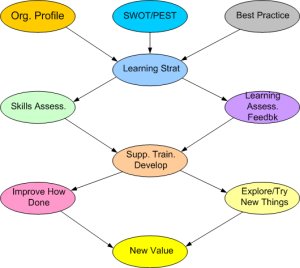
Need to develop organisational learning strategy to underpin organisations learning. Need to:
Understand strengths and weaknesses of current knowledge and learning processes
Understand industry trends, individuals ideas and their potential for creativity
Understand what is best practice in the field
Organisational Tools for the Job
Need to obtain or develop tools that will:
Give an accurate picture of the organisational profile: What is the current learning level of the employees of the organisation?
01. What information do employees acquire? How do they use it? What happens to it?
02. What information do staff create? How is it used? What happens to it?
03. Where is it stored? Who has access to it? How often is it used? What for?
04. Is it updated? Is it ignored?
05. How is it applied in the workplace? What purpose does it serve?
06. What indicates processes are productive or creative?
07. Do information processes lead to new ideas?
08. What processes examine new ideas and make them reality?
09. How many ideas are coming through?
10. How many are tested and rejected, how many accepted and lead to innovation?
11. Why and how are they rejected?
12. Why and how are they accepted?
13. What are the acceptance and rejection criteria?
14. Are new ideas on the increase or decrease?
15. Why?
Analyse strengths and weaknesses: SWOT, PEST, DEPICTS or similar tools.
Exploit best practice: Find out what is best practice and exploit it to lead improvement.
Make Learning Work for the Individual
Three normal channels which may pay lip service to learning:
Rhetoric advocates what people would like to believe should happen but has no basis in reality.
Training Days provides training input does not ensure learning or take account of learning styles.
CPD tends to measure inputs, not developments or outcomes. This is changing.
Learning Tools
Used by Chartered Institute of Management
Smart Management Assessment questionnaire assessing ability across range of areas. Personal version of SWOT.
Smart Skills Benchmarks set of diagnostic tools that allow you to measure and others to provide feedback across a range of areas.
Smart Learning Assessment examines learning and application of new skills in workplace.
All this informs the organisation learning strategy.




No comments:
Post a Comment