Sunday, July 11, 2004

Latest Transport from Preston

Leave at about 9.30 for the steam fair. I wanna get there smartish, it'll secure us some dry parking and we can chill and find our bearings. Drive down is uneventful, location is as described by Tracy. Off road driving is OK and I even manage to resist the temptation to runover the assorted ATC people guiding us to the car park. They all seem to be suffering from the usual misapprehension that they are disguesed as bushes. First port of call is the bog block. Not because we require them right now, but we need to know where they are, it's a parent thing I've discovered over the last five years. The air smells of coal/coke or whatever it is you burn in traction engines and is thick with steam. Cool. First engine we come across is this thing. Don't look speedy but is remarkably Callum sized. This suggests that the geezers of yesteryear really were a bunch of midgets which confirms the impression I had when I visited the Victory many moons ago. Now if I can call them midgets they must have been tiny. I come to the conclusion that the Battle of Hastings was conducted by a bunch of psycho-norsemen that had discovered garlic and beer monster Saxons that were in reality about 6 inches high. They'd do mean things to yer kneecaps now. Callum plots a slow getaway... 
Callum plots a slow getaway... Posted by Hello

Steam Ahead

Cal and I to keep quiet today while Monst sleeps are off to the Cheshire Steam Fair. A freebie gig courtesy of Northern Primary. So expect pics of traction engines later! Star of the show is the Iron Maiden mind you the reviews quite harsh on the film. It ain't a great movie but palatable Saturday or Sunday afternoon stuff.

Saturday, July 10, 2004

Strategy in a Week - Saturday

Seven Thought Starters

  • Seriously question if not ignore tradition
  • Involve everyone in both top down bottom up approach customer should always be the focus
  • Avoid paralysis by analysis
  • Encourage and foster innovation throughout the organisation
  • Go for balance between getting things done and doing new things
  • Embrace conflict and plan to exploit it
  • Remember strategy never stops

  • Das Boot

    Bung the kids in the car. Cal and his mate from school Aaron and away we go to the Historic Warships. Monst hates the tunnel and closes her eyes, sticks her fingers in her ears and mutters la-la-la as we travel through the thing. Quite puts me off the sounds of Mr Newell (she later deigns to laugh at the bit of Giles Smith's 'Lost in Music' where he fears being crushed by heavy instruments, an ex-member of the Damned and several cans of warm piss, who knows next week I may sell her on the music). This is Monst's first visit to the ships. Not mine and I always get kinda melancholy round the place because Tom and I came a couple of times. The kids enjoy it but the announcement warning parents not to let their kids run around on the ships is embarrassingly close to home. The Onyx goes down well as ever, nice old boy in charge swigging tea and claiming to be ex-special forces. I feel a bit of Baron Munchausen coming on as porkies of Shoebridge proportions are likely to follow. Mind you he was pleasant enough but I'd be frightened if I were a cup of tea. As ever the U534 amazes me to look at but I've still yet to trip round it. Cup of coffee in the cafe on the Plymouth and I listen in to several naval and wannabe naval types decrying the state of the modern navy. I agree with them, since they dropped rum, sodomy and the lash the thing ain't been the same. I also agree we couldn't re-invade the Falklands now, we know the place is full of sheep and we don't have that Psycho-Thatcher requiring a war to secure re-election, no we have Blair who wants a war to ensure a loss in the next election...... Home via Speke and our first encounter with printing from the digital camera. Machine in Boots easy to operate, not overly pricy but when it runs out of paper can they find the key to replace the roll, can they buggery. Chaos. Still the results aren't bad. Put in the 35mm spool from the new camera too. Monst pleased with the results. Result then. Home, Ying Wah for dinner, Monst at work, I blog, Cal watches Eddie Murphy in Haunted Mansion the review explains why I ain't watching.

    Plant...Cor!

    Nice bit of plant... 
    Nice bit of plant... Posted by Hello

    Dad'd be Proud, Historic Warships Everywhere and I'm Interested in the Brickwork

    What else do you expect from the son of a brickie?
    What else do you expect from the son of a brickie? Posted by Hello

    Cute Submarines....

    Monst, Aaron and Callum before I shoved
    Monst, Aaron and Callum before I shoved 'em in the torpedo tubes...... Posted by Hello

    Angelic Upstarts


    'So if we press that button the guns go bang?' Posted by Hello

    Sunk, Raised, Lands in Birkenhead


    Das Boot Posted by Hello

    Let There Be Light

    I see the light.... 
    I see the light.... Posted by Hello

    Bang, Bang, The Mighty Fall

    >Duck, they
    Duck, they've let the little bugger loose with something dangerous. 
    Posted by Hello

    Support the RNLI

    RNLI Contributions Always Welcome - Er...Can I still drink in the Harbour Bar Portrush, Guv?
    RNLI Contributions Always Welcome - Er...Can I still drink in the Harbour Bar Portrush, Guv? Posted by Hello

    Strategy in a Week - Friday

    Towards a New Strategic Model The Learning Organisation

  • Harness organisational knowledge: organisation needs to know what it knows and what it doesn't
  • Potential for creativity and innovation: individual comes up with the ideas and organisation that innovates. Requires the following core competencies 1. Toleration of failure, support and focus on learning 2. High regard for individuals 3. Willingness to alter targets 4. Real, not rhetorical openness and honesty 5. Link individuals development to organisational goals 6. Balance risk with progress If not in place innovation will be stifled.
  • Mix of old and new technologies: need convienience of e with human touch. Hybrid is best.
  • Leadership learns, listens and grows the organisation: know when to be hands off.
  • Evolution not revolution: revolution is not sustainable, evolution is. Making Change Happen Need to harness yourself to perpetual change but beyond improving what you do, invent something that isn't there. Reinvention requires employees to:
  • Believe and have the power to make things happen.
  • Identity, is it to unit or organisation as a whole. Are people encouraged to see the bigger picture?
  • Conflict, do you smooth over to maintain status quo or address the issue?
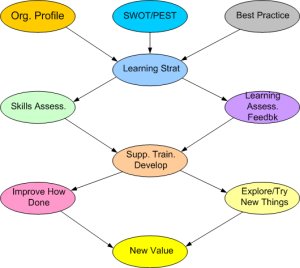
  • Learning, how does the organisation handle new ideas? Towards an New Strategic Framework Need to develop organisational learning strategy to underpin organisations learning. Need to:
  • Understand strengths and weaknesses of current knowledge and learning processes
  • Understand industry trends, individuals ideas and their potential for creativity
  • Understand what is best practice in the field Organisational Tools for the Job Need to obtain or develop tools that will:
  • Give an accurate picture of the organisational profile: What is the current learning level of the employees of the organisation? 01. What information do employees acquire? How do they use it? What happens to it? 02. What information do staff create? How is it used? What happens to it? 03. Where is it stored? Who has access to it? How often is it used? What for? 04. Is it updated? Is it ignored? 05. How is it applied in the workplace? What purpose does it serve? 06. What indicates processes are productive or creative? 07. Do information processes lead to new ideas? 08. What processes examine new ideas and make them reality? 09. How many ideas are coming through? 10. How many are tested and rejected, how many accepted and lead to innovation? 11. Why and how are they rejected? 12. Why and how are they accepted? 13. What are the acceptance and rejection criteria? 14. Are new ideas on the increase or decrease? 15. Why?
  • Analyse strengths and weaknesses: SWOT, PEST, DEPICTS or similar tools.
  • Exploit best practice: Find out what is best practice and exploit it to lead improvement. Make Learning Work for the Individual Three normal channels which may pay lip service to learning:
  • Rhetoric advocates what people would like to believe should happen but has no basis in reality.
  • Training Days provides training input does not ensure learning or take account of learning styles.
  • CPD tends to measure inputs, not developments or outcomes. This is changing. Learning Tools Used by Chartered Institute of Management
  • Smart Management Assessment questionnaire assessing ability across range of areas. Personal version of SWOT.
  • Smart Skills Benchmarks set of diagnostic tools that allow you to measure and others to provide feedback across a range of areas.
  • Smart Learning Assessment examines learning and application of new skills in workplace. All this informs the organisation learning strategy. Learning Strategy Framework

  • Hey Kidz....Pin Back Your Ears, I am About to Confirm Your Fears, I Was a Teenage Idiot Dancer, For Years and Years

    Wake, washup, make coffee, turn on 6 music, watch a skip being delivered and one being taken away across the road with Callum who gets excited about that sort of stuff (me having filled a few in the past during summers working the sites with the old fella, when amongst other things I was attacked by psychotic chickens and developed skills as a toad and frog diviner, I was less excited by it). Normal morning then. The music's good and we return to Birkenhead's Historic Warships with Cal and Aaron today. Maybe the odd pic'll appear later. Need to get on with the strategic crap because I'd like to start writing the thing tomorrow night. He has heart surgery and now 6 music have Bowie day. I ain't a big fan. Couple of tracks I really like, like 'Heroes' but nothing that makes me wanna buy his stuff.

    Friday, July 09, 2004

    Strategy in a Week - Thursday

    Strategic Thinking Looking for Something Different Identify what customers value, get them involved and tailor it so it's outside the norm. What Strategic Thinking Involves May be either formal or informal, whatever works for you. Preferably with someone you spark with.

  • Cast off risk averse culture: create an environment where punk give it a go ethos works
  • Kick around ideas in a climate where all colleagues are equal and information share
  • Look for new voices who don't come up with the same stale ideas
  • Release desires and passions to make difference happen
  • Use brainstorming to promote creativity
  • Challenge old assumptions and don't worry about the fit of new ideas
  • Remember individual learning and development are at the heart of strategy
  • Try new things despite the conflict this may bring Harnessing Conflict Need mutual trust, respect and empathy. Throw out any shit relating to position or status. Avoid:
  • Notion that knowledge is privilege of status
  • Ignoring undercurrents or sweep differences under the carpet
  • Don't ignore 'off-the-wall' comments
  • Be ruthless with short-term views that may lead to return to status quo, return to norm, protection and face-saving
  • Short term projects that divert you away from the main focus of business Getting Involved
  • Get out and about and build relationships
  • Be honest about what you get right from the perspective of others
  • Make suggestion schemes work by thinking about reward
  • Identify what all can offer to the shared goal
  • develop trust between members of organisation and elements of the organisation
  • Give people time to feel their way. Finding Time Set aside time for:
  • planning development activities
  • coaching colleagues
  • building relationships
  • getting honest feedback on the way we work
  • concentrate on personal development
  • take time to read and explore pastures new Knowledge sharing is key to successful implementation of strategy. Knowledge is not the province of the individual but the corporate body. Key Questions
  • Strategy: does everyone know what they're doing and they're contribution to strategy development?
  • Leadership: does the leader provide a role model?
  • Customers: does everyone understand their needs and expectations?
  • People: do your people naturally develop, think about what comes next?
  • Control: does measurement and procedure stifle creativity?
  • Integration: do we mix across organisation?
  • Processes: what are the key processes and activities of the business?
  • Focus: short term or future? Need to think about the following in three and five years time:
  • Who will be our customers?
  • What will be their concerns and priorities?
  • What kind of lifestyle will they have and expect?
  • How shall we get close to them?
  • How will customers prefer to access services?
  • What channels will we use to get to them?
  • How do we adapt service to future needs?
  • What should we do to develop knowledge, exploit information and invest in skills.

  • I heard a whisper today, that the world would end on a weekday, leaving me free to take a long weekend

    The music I was worried about turns up today. 'Rotten Soul' gets a full listen through. Might need a little getting used to on the basis is it sounds like an older Jazz Butcher, which is logical because it is. Some nice stuff I think. Listen to a bit of Cleaners from Venus too but I save the Le Tigre until now when I can listen properly. the others I know I'll like and love even if it requires some effort. This though is a purchase on the basis of a line in a song of Amelia Fletcher's and as a result could be dreadful or great. First track reminds me of X-Ray Spex and I'm warming to it already. May take a few listens but I suspect I'm gonna want more. That it's on Wiiija helps. A nice label. Yes not only will I buy stuff on the basis of throwaway lines but labels I like will also be a factor. Cal's school buffet (picnic is kinda unfair to it) saw me playing bingo, us win a box of chocs and six pack of confused beer (Bavaria from Amsterdam?). Nice to meet other parents and good to support the school but coulda lived without it to be honest. Still responsible parent I'm meant to be I guess you gatta do these things.

    Strategy in a Week - Wednesday

    Strategic Analysis What is Strategic Analysis About asking the right questions and remembering answers are from past and present so may be no guide to the future. Need to consider:

  • Wider environment and its significant influences (look for change and discontinuity)
  • Our organisation's strengths and weaknesses
  • Our competition, opportunities and threats Environment PEST divides environment into four categories
  • Political
  • Economic
  • Social
  • Technological Useful way to understand the environment we work in. PEST Analysis DEPICTS may provide a better picture (Don't expect this in the book this is a pure Scouse departure based on stuff from JMU) DEPICTS divides environment into seven categories
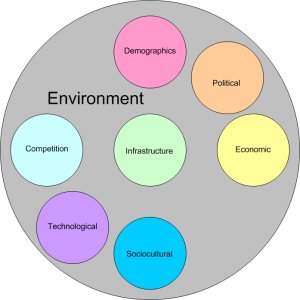
  • Demographic
  • Economic
  • Political
  • Infrastructure
  • Competition
  • Technological
  • Sociocultural DEPICTS Analysis Analysing the Organisation SWOT analysis probably the most useful tool. Identifies how well placed our organisation is. Key thing with SWOT is keep it focused and don't do it alone.
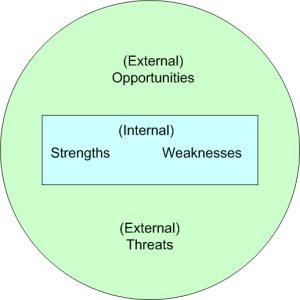
  • Strenghts
  • Weaknesses
  • Opportunities
  • Threats SWOT Analysis Analysing the Competition Porter's Five forces model can be used to analyse the competition:
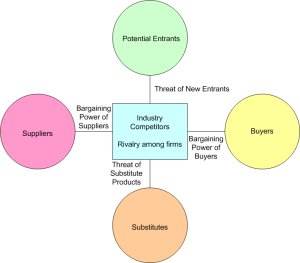
  • Competative rivalry: how many people are going after the same business
  • Power of suppliers: how much power fo they have to influence costs
  • Power of buyers: increases if they are small in number relative to no organisations
  • Threat of substitutes: if alternatives will do no chance to raise prices
  • Threat of potential new entrants: how easy is it to enter market and add to rivalry 5 Forces Analysis Need to maintain differnetiation with rest of competition. This is a constantly moving target. Key Trends Affecting Environment
  • Globalisation: market no longer just local
  • Technological advancement: changes way we operate
  • Societal change: Key thing is what you know and how you use knowledge
  • Organisation is a group of stakeholders e.g. suppliers, customers, employees etc.
  • Reliance on innovation for success: stay still you stagnate
  • Competition: monopolies seldom exist
  • Diverse workforce: enriches the organisation
  • Changed organisational structure: tends to be more flexible
  • Lifelong learning: needed to keep pace with change
  • Change cycle: is speeding up. Don't dwell in the past Use the tools to understand current state of play and then develop an understanding of the future.

  • "Was it terribly beastly?" she enquired

    Break in the getting my head round the strategy thing (not impressed by the last chapter I did - thought it gave me very little of use - but that's books). Cal's school picnic this afternoon (I'm taking the afternnon off to attend). Highlight to look forward to then. Better put the back seats up for Cal and Aaron. Promised Callum that we'd do some baking when we got home. All that weighing of stuff'll be good for him. Need to pick up a few ingredients and decide what to bake. Waiting on a delivery from Amazon of Le Tigre's first album, the latest offering of the Jazz Butcher (that isn't a compilation anyway) 'Rotten Soul' and the 'Very Best of the Cleaners from Venus' which includes a couple of fave tracks in 'Illya Kuryakin Looked At Me' and 'I Was A Teenage Idiot Dancer' and involves the truly wonderful Martin Newell and Giles Smith (who is now writing for The Times on TV). Thing is they say they posted it on the 2nd and it ain't here yet, so I'm anxious.....

    Thursday, July 08, 2004

    Strategy In a Week - Tuesday

    Strategists and Strategies H. Igor Ansoff Identified there is no universal success factor (Strategic Success Paradigm). Aggressiveness of strategy should match change in environement. Henry Mintzberg Differentiates between strategy and planning. Strategy identifies change when it occurs, identifies discontinuities and opportunities and exploits them creatively. Too much emphasis can be placed on planning. Michael Porter Suggests that a move from e-business to business will happen as universal use of the web occurs. All business subject to the five forces:

  • Right goal.
  • Value: must offer benefits in addition to competition.
  • Value chain: must differ from rivals to deliver benefits above rivals.
  • Trade offs: sacrifice some areas to excel in others.
  • Continuity: to build competative edge. Key read (need NHS Athens for link to work) Gary Hammel Suggests:
  • Be subversive, ignore convention aim to be unique
  • Promote change, don't get swept along with it.
  • Let everyone have their voice
  • Take risks Management there to:
  • Sponsor thought about chage and discontinuity
  • Consider new ideas openly and honestly
  • Get involved in the learning process, cast off ominiscience
  • Foster intrapreneurship and creativity Ricardo Semler Give control to the employees, let your people lead you. Uses the following operational principles:
  • Forget about the topline - don't set financial targets
  • Don't forget the start up mentality - ask what you'd lose if you shut down
  • Don't treat employees like children - if you do that's what you get
  • Let people choose where they work - even their leaders
  • Make decisions quickly and openly - bureaucracy kills initiative
  • Partner promiscuously - each new venture means a new alliance
  • Stay free - don't plan, no rules, don't wield power Key read (need NHS Athens for link to work) Differentiate with strategy Dairyborn shifted from niche in supplying grated cheese to pizza vendors to food manaufacturers in response to others moving into market. First Direct 24/7 banking. Key lesson - differentiate. Common factors in great strategy
  • Be different
  • Learn from the past but focus on the future
  • Continually change
  • Push back the boundaries
  • Be innovative
  • Involve people in the organisation
  • Develop flexible, continuing strategy

  • Strategy In A Week - Monday

    Strategic Models Growth Model Key issue grow the market by reducing production costs and increase sales opportunities. Very difficult to keep a growing market to yourself. Porters Five Forces Model Either become lowest cost producer or differentiate products and achieve premiuim price. Need to select an approach to:

  • Customers
  • Suppliers
  • Substitutes
  • Competitors
  • New Market Entrants depending on whether industry conditions are fragmented, emerging, mature, declingin or global. Competative advantage stems from:
  • Reducing influence of customers and suppliers on pricing.
  • Reducing the impact of susbstitutes on product.
  • Reducing rivalry to reduce competition and nullify the impact of new entrants. Ability to implement constrained by ability to collect and interpret data. Growth by Diversification/Acquisition Buy your way to success or enter new markets. Tools to help include:
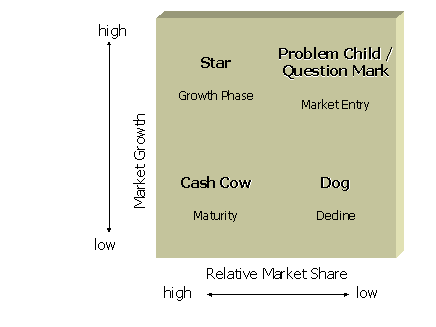
  • McKinsey/GE Matrix - Suggests aquisition when an organisation is building strong strategic position with low market attractiveness and divestment when competative position is eroded. McKinsey/GE Matrix Boston Box Boston Box Three critical tests for fesibility of acquisition:
  • Attractiveness - is the industry attractive? Few rival products, stable competition and suppliers and customers have moderate bargaining power?
  • Cost of entry test - does the cost on entry risk return on investment?
  • Better off test - will you gain competitive advantage All this requires constant viewing of the extternal and internal landscapes. Porter's Value Chain Focuses on strenght and weaknesses of the supply chain to customers. Primary activities:
  • inbound logistics: materials handling, warehousing etc.
  • operations: raw material to finished product
  • outbound logistics: processing orders and distribution
  • marketing and sales: comms and price
  • service: installation and after-sales Secondary activities support primary:
  • procurement: purchasing and supply
  • technology development: know how, procedures, skills
  • human resource management: recruitment, appraisal, development and reward
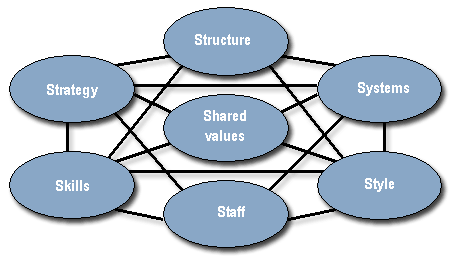
  • firm infrastucture: general management, quality, planning and finance. All links in chain must chain and be strong. Weaknesses affect chain as a whole. Core Competencies Analyses what you do better than others. Need to define critical activities and skills to enable them and invest in them. McKinsey Seven S Model Bases success squarely in motivating staff. McKinsey Seven S Model Key Questions to ask all the time
  • What is the organisation trying to achieve?
  • What should it really be doing?
  • Is there a difference between what it says and what it does? If a model helps structure the answers, fine, use them as tools. Remember all above are old hat. New tools next.....

  •